Friday, September 30, 2005

Bonner Retires and Wrap-up Report from MIT Supply Chain Event

Last Thursday I had the pleasure of attending the MIT Resilient and Secure Supply Chain conference in Cambridge, MA. Despite a five hour flight delay on the way home it was well worth the trip. MIT professor Yossi Sheffi kicked off the conference with some highlights from his new book The Resilient Enterprise. Yossi made some excellent points about the value of a resilient supply chain supported by several analogies that I was not aware of, such as the fact that Ericcson no longer makes cellphones mainly due to a supplier fire in Mexico that basically took so long to fix that they missed the window of opportunity of camera phones to Nokia and closed up shop (which is also why they partnered with Sony). Or Toyota who lost a supplier that made small tubes due to an earthquake in 1997. Within 24hrs Toyota's other suppliers, including Brother, know for its fax machines, started producing the tubes for them during the crisis without even asking for payment or a PO number. After Toyota was back into production and selling the cars they not only repaid the suppliers, but they gave them 1% of the total car sales as a bonus. A great example of partners helping to achieve resiliency.

Yossi was followed by IBM's Theo Fletcher who discussed IBM's supply chain and how he is making sure that the $68 million dollars in IBM's goods that are shipped globally each day make it to their destination securely and on-time. Theo couldn't emphasize enough that industry needs to lead security efforts, while working closely with governments and industry organizations

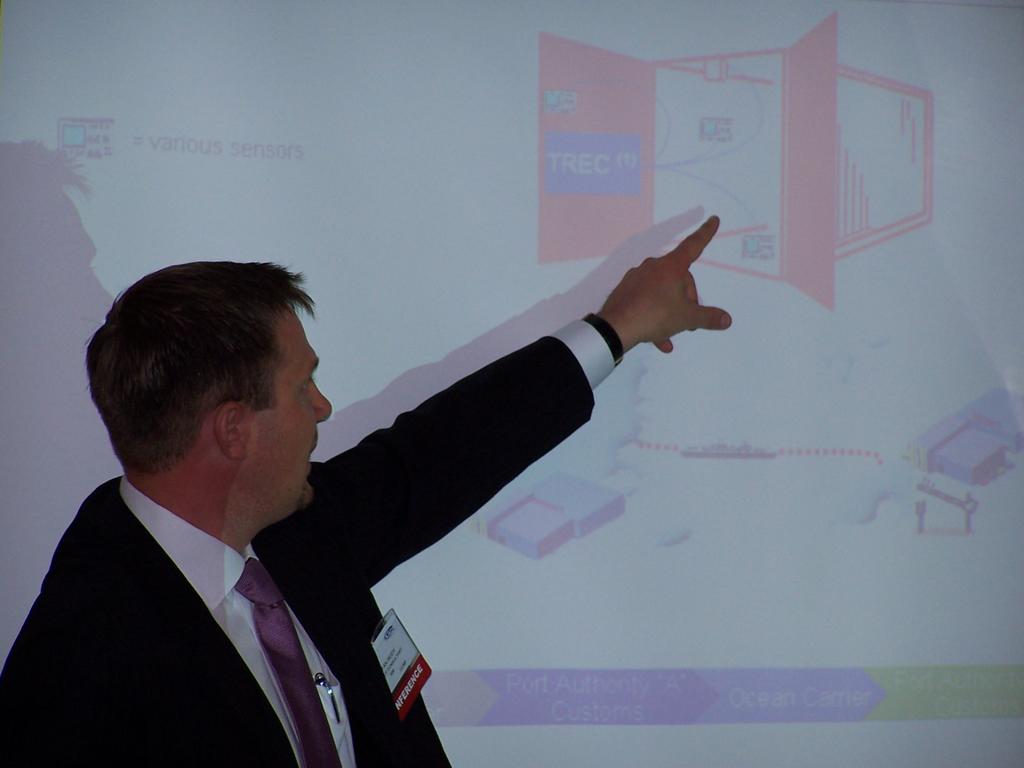
After lunch Commissioner Robert Bonner, US Bureau of Customs and Border Protection took the mic. Using no slides, he spent the next 45 minutes discussing what it's going to take to make a globally secure supply chain. He commented on the success of C-TPAT, which in less than a few years went from 7 members to more than 3000 (9000 applications are pending). He also applauded the efforts of the World Customs Organization (WCO), which has 89 countries of 168 that have already declared their intent to begin implementing the WCO Framework. The Commissioner also stated some interesting statistics including, the top 1000 importers account for 62% of all goods imported in the USA, C-TPAT covers 40% of all containerized goods and 80% of imports come through CSI ports in the US. All very strong statements that lead up to his announcement that he is going back to the private sector beginning in December. That's right, America's first Commissioner of the Bureau of Customs and Border Protection is retiring after 4 years. Incredibly, his first unofficial day in office was September 10, 2001.
Photo credit: Justin Knight Photography

Tuesday, September 27, 2005

The West Wing and Forbes Logistics Goes Live

Back in August, I reported that the Forbes.com was launching a supply chain logistics website in the business section of the Forbes.com website managed by supply chain pundit Bob Malone. Well the site is now live and features both editorial and video content.

As I said in August, this is significant because it elevates the supply chain to the readers of Forbes.com, which 25% is comprised of c-level executives and senior management, according to its demographics breakdown. So the supply chain is making it out of the basement and into the boardroom. Good news for all.

Lastly, in my quest to highlight the use of supply chains in Hollywood, last Wednesday's episode of the West Wing (a drama sitcom based on a fictitious White House) featured the Port of Baltimore. The Port was used for a campaign speech on homeland security by the vice president-elect Leo McGarry. It was probably filmed on some studio lot, but it was good to see that even Hollywood recognizes that securing the US Ports should be and is a top priority.

Wednesday, September 21, 2005

New Real Time Cargo Security Tracking with Zigbee

Today I attended the US Maritime Security Conference in New York City at the Javits Center. IBM and Maersk Logistics kicked off the show with a press conference announcing real time monitoring for cargo security called TREC or Tamper-Resistant Embedded Controllers. The brains at IBM Research developed the controllers using a plethora of propeller head technology, including iridium satellite GPS and a wireless open standard technology I never heard of called Zigbee. Zigbee is as cool as its name implies. Imagine a stack of cargo containers five high by twenty long. With RFID you can attempt to scan the entire lot, but chances are you will not get a reading on the bottom containers. Using the Zigbee wireless technology, the containers on the bottom form a virtual link to all of the containers in the lot to identify themselves, which then gets passed up to the reader. So none of the containers get missed.

The TREC controllers come standard with eight sensors, which can pick up changes in temperature, climate, tampering, lighting and radiation. Up to 65,000 sensors can be included on the TREC tags, depending on the type of cargo. So for example, if you are shipping chocolate bars from Europe and the temperature drops below room temp, the TREC tags can notify the shipper, the retailer or the manufacturer that the bars are now syrup. Competitive advantage, you bet.

IBM and Maersk plan to start a pilot this November and then by the 2Q next year the devices will be commercially available. The question came up several times during the press conference about the cost and ROI. While the cost is still being determined, the ROI can be looked at several ways. Maresk Logistics can offer this to its clients as a competitive differentiator in a field that is very similar. For manufacturers and retailers, it could lead to faster customs inspection, which means faster time to the store shelves and real-time updates can allow for last minute changes to the port of destination, which could be crucial when one is trying to avoid a closed port for example like in New Orleans. So ROI may not be directly in dollars and cents, but the collateral benefits are clear.

Wednesday, September 14, 2005

Whose Fault is a Supplier's Lack of Ethics?

An interesting article appears in today's NY Times by Steven Greenhouse with the headline "Suit Says Wal-Mart is Lax On Labor Abuses Overseas." To summarize, a labor group filed a class action lawsuit aganist the retailer for not enforcing its code of conduct for overseas suppliers. Several codes were broken such as, payroll violations, physical abuse and long hours. Some of the accounts are abhorring, including one worker that was slapped so hard her nose bled and another employee was locked inside the building overnight. But is this Wal-Mart's fault?

Wal-Mart contends that they have 200 inspectors that search 30 factories a day. With 5,000 factories it will take them approximetly 167 days to inspect them all, which shows a real commitment to addressing the problem.

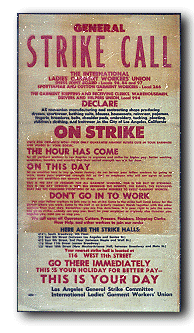
The article continues to explain that if the workers file in their home countries they face arrests and physical attacks. This is not unlike the United States from the 1800s to the 1940s. Paid by the piece, seamstresses often worked 16 hours a day and their income rarely exceeded bare subsistence. This resulted in the forming of unions, which virtually whipped out unions in the US by 1938.

I'm no international labor expert, but why isn't this an option instead of the fruitless lawsuits?

Tuesday, September 06, 2005

CSI: Supply Chain

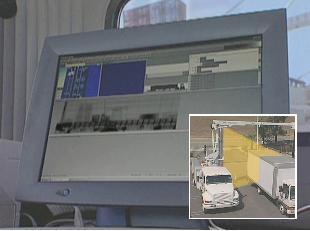
For those of you not in the United States, CSI or Crime Scene Investigator is a huge hit TV show on CBS. The original show took place in Las Vegas and was quickly followed up by CSI: Miami a few years ago. Last night's episode had the CSI crew solving a murder mystery involving counterfeit US $50 bills. To make a long story short, the CSI team discovered that the counterfeit money was being shipped from the Port of Miami in freight containers. To find the containers before they shipped out, Horatio Caine, the lead CSI detective, teamed up with US Customs & Border Protection (CBP) and used a (Vehicle And Cargo Inspection System (VACIS) that uses gamma radiation (click for video demonstration) to scan and look in the freight containers to find the suitcases that contained the counterfeit cash. While this may look like the magic of Hollywood the technology does work and is in use today at many US ports. The scanning of a 40 ft container is done in 6 seconds so one could imagine how helpful it could be in scanning the thousands of containers that arrive in a port daily.

So what's next CBP: Los Angeles? Stay tuned.