

This past weekend I had Sunday lunch with five of my cousins, nieces and nephews ages 8-11. They had no idea what I did for a living so I happily gave them an introductory lesson on supply chains and how they impact their young lives. They initially were more interested in me getting them a free computer, but I pressed on and spent a few minutes discussing globalization when I was asked an disturbing, yet interesting question, "Why can't we make sneakers in the USA"? After giving my nephew a confident, "we certainly can" response he countered with, "then why are my sneakers made in China"? It then dawned on me that he thinks that "made in China" implies that we simply aren't smart or savvy enough to make sneakers here in the US. I then briefly reflected on what a strange world we would live in if we could make a rocket go to the moon, yet we can't make a pair of comfortable shoes. After laughing at my own thought, I took a quick poll of my other young relatives and they either didn't know what it meant or they agreed with him.
As we look to encourage America's youth to become scientists and engineers I couldn't determine if his thinking will be motivational or not. Either way they need the facts. After explaining in simple terms that while his sneakers are made in China it has nothing to do with America's sneaker making abilities, but more about cost and competing on a global scale. My niece then asked if she should only buy American made products. Which I told her is perfectly fine idea if she doesn't want to use her cellphone or play any more video games. She gave me a inspired look and said, "I'll make my own out of play-doh". Now that's the spirit!
Subscribe To

 Posts
All Comments
Posts
All Comments
Wednesday, February 22, 2006


Friday, February 17, 2006
Globalization: Coming to a Town Near You
Two weeks ago I attended an internal meeting in Orlando discussing globalization. If I had to summarize the two and half days I spent it would go something like this - Globalization is bringing about new rivals, new technologies and new regulations. These changes often begin as weak signals at the periphery, so the trick is how do you pick up these weak signals and act on them ahead of everyone else? Part of the trick is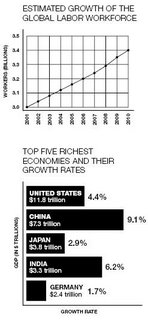 knowing the facts, which begins with canvassing the global landscape and bringing together multiple data points to form a realistic picture of the global business environment— whats changed, and what is changing. Honing your ability to cut through a world of information overload and uncertainty in other words, foresight will be among the most important requirements for the tasks ahead. While I can't share with you the specifics of what was said, I thought these statistics below would be of some value and interest.
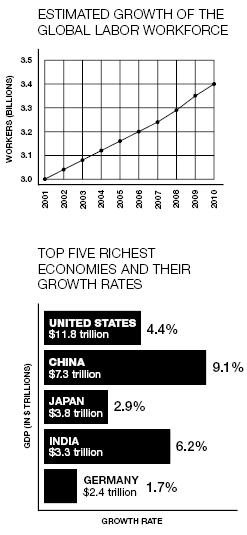 knowing the facts, which begins with canvassing the global landscape and bringing together multiple data points to form a realistic picture of the global business environment— whats changed, and what is changing. Honing your ability to cut through a world of information overload and uncertainty in other words, foresight will be among the most important requirements for the tasks ahead. While I can't share with you the specifics of what was said, I thought these statistics below would be of some value and interest.
- The world economy is projected to be about 80 percent larger in 2020 than it was in 2000 and average per capita income to be roughly 50 percent higher
- By 2010, 90 percent of all Ph.D. Physical Scientists and Engineers will be Asians living in Asia
- To sustain current levels of economic growth, China needs to generate 10 million jobs every year
- Thirty years ago, the ratio of managers to administrative jobs was 1 to 6.88. Because of automation, that ratio today is nearly 1 to 1
- A typical large business in 2010 will have fewer than half the management levels of
its counterpart in 1990, and about one-third the number of managers - Over the last 10 years, the number of Japanese companies on the Global Fortune 500 dropped from 149 to 82, while the number of Chinese companies rose from 3 to 16
Friday, February 10, 2006
Using a Labor Supply Chain to Build Teams By Personality
In previous blogs I've discussed how supply chain principles could and are being applied to a labor pool. At an event this week in Greenwich, Connecticut I along with several of my colleagues participated in a roundtable discussion on this topic with IT analysts and university professors that study supply chains. After taking them through the strategy and implementation some interesting comments and suggestions came up that I want to share.
If you haven't read my earlier blogs on this topic you may need to do so to understand how this fits in, but I'll try to summarize. Essentially, IBM is in the process of cataloging the skills and talents of its 190,000 IBM's Business Consulting Services division - so for example if and when a client needs a Russian and French speaking RFID expert that is familiar with the automotive industry in St. Petersburg on March 10th we can find that person in seconds. The backdone of this strategy is a common database or taxonomy that categorizes skills, language, job experience, etc. This is being done today and by the end of the year it will be completely up and running globally with 1 million employees and contractors.
Now here is what gets really interesting. What if we added a personality category. So not only could you search based on skills, but on if the employee gets along with others, is a leader or a follower or if the person is shy and typically likes to told what to do and left alone. Using something like the Myers-Briggs Type Indicator as the framework, employees could take the test and then be categorized. This data could be used to build teams for long term client engagements and to match client personalities with consultants. The other thought was to also add a customer sat rating, similar to the ratings for eBay sellers and buyers. (Here is an example of what the database could look like)
 Obviously, privacy issues arise, but it's an interesting concept. One of the roundtable participants told a startling story about the nature of airline pilots. Today, airlines run personality profiles on pilots and co-pilots to make sure that they are compatible. Apparently, several times in the 80s planes crashed because the pilots refused to take orders from each other and preferred crashing to submission. I'd take giving up a little privacy over a crash and burn any day. What are your thoughts?
If you haven't read my earlier blogs on this topic you may need to do so to understand how this fits in, but I'll try to summarize. Essentially, IBM is in the process of cataloging the skills and talents of its 190,000 IBM's Business Consulting Services division - so for example if and when a client needs a Russian and French speaking RFID expert that is familiar with the automotive industry in St. Petersburg on March 10th we can find that person in seconds. The backdone of this strategy is a common database or taxonomy that categorizes skills, language, job experience, etc. This is being done today and by the end of the year it will be completely up and running globally with 1 million employees and contractors.
Now here is what gets really interesting. What if we added a personality category. So not only could you search based on skills, but on if the employee gets along with others, is a leader or a follower or if the person is shy and typically likes to told what to do and left alone. Using something like the Myers-Briggs Type Indicator as the framework, employees could take the test and then be categorized. This data could be used to build teams for long term client engagements and to match client personalities with consultants. The other thought was to also add a customer sat rating, similar to the ratings for eBay sellers and buyers. (Here is an example of what the database could look like)
Obviously, privacy issues arise, but it's an interesting concept. One of the roundtable participants told a startling story about the nature of airline pilots. Today, airlines run personality profiles on pilots and co-pilots to make sure that they are compatible. Apparently, several times in the 80s planes crashed because the pilots refused to take orders from each other and preferred crashing to submission. I'd take giving up a little privacy over a crash and burn any day. What are your thoughts?
Thursday, February 02, 2006
Milk and Gas: Inextricably Linked Prices
With all the recent hubbub about gas prices it made me think of a few comments I heard at a supply chain conference a year ago by an executive in the petroleum industry about the milk industry. Whether it's milk or soda, the other caramel-colored liquid that Americans are obsessed with, the prices of each have risen just as steadily over the past few decades, yet no one seems to be protesting. The speaker went on to discuss the milk supply chain and comment that in many US States, milk is pumped, pasturized, packed and typically shipped less than a few days, which then gets trucked on average only a hundred miles from the cows, which are plentiful and which don't require billions of dollars to maintain. Compared to the oil industry, oil first needs to be discovered in remote areas like the Artic regions or in war zones such as the Middle East, which costs lives and hundreds of millions of dollars, before a gallon is even seen. Then on the chance that its discovered, only 1 out of 7 digs actually find the stuff, it needs to be pumped u p from miles below the earth's crust, which then needs to be refined and finally shipped for days, thousands of miles across the ocean in huge tankers then transferred to trucks. And yet the price of a gallon seems to stay on par with the cost of milk, which has a much faster and smaller supply chain. To give you an idea, since the early 1980s, milk prices have gone up about as much as gas prices - more than 80 percent in both cases, according to the latest available federal Bureau of Labor Statistics figures, which run through June.
Last time I checked we didn't have a massive gas pipeline running out of Madison, Wisconsin, so what gives? Where do these costs come from? Obviously, taxes add to high costs of gas, but my point is the reaction Americans have to the price of gas is unjustified. According to CNN, our friends in Italy pay $4.86 a gallon or even worse in England its five and change. So it could be a lot worse. So either buy a fuel efficient car or use alternative fuels. I hear switch grass is an idea.
 p from miles below the earth's crust, which then needs to be refined and finally shipped for days, thousands of miles across the ocean in huge tankers then transferred to trucks. And yet the price of a gallon seems to stay on par with the cost of milk, which has a much faster and smaller supply chain. To give you an idea, since the early 1980s, milk prices have gone up about as much as gas prices - more than 80 percent in both cases, according to the latest available federal Bureau of Labor Statistics figures, which run through June.
Last time I checked we didn't have a massive gas pipeline running out of Madison, Wisconsin, so what gives? Where do these costs come from? Obviously, taxes add to high costs of gas, but my point is the reaction Americans have to the price of gas is unjustified. According to CNN, our friends in Italy pay $4.86 a gallon or even worse in England its five and change. So it could be a lot worse. So either buy a fuel efficient car or use alternative fuels. I hear switch grass is an idea.
Subscribe to:
Posts (Atom)