

In previous posts I have written about how supply chain principles can be applied to managing a global labor force and how organizations are looking to managing skills and talent just like they do parts inventory. But now I'd like to take that strategy a step further and instead of managing employees, how about using a supply chain to manage your customers, which in the case of the airline industry are passengers. Think about it. Why couldn't UPS, FedEx or DHL buy an airline and manage it just as efficiently as it does packages? While I agree many differences could be pointed out, I think just as many similarities and synergies could also be made. Maybe UPS has already considered this since its website indicates that its fleet makes it the 9th largest airline in the world.
I'm in the platinum club for both American Airlines and Delta, so I fly quite often. I also ship plenty of packages using UPS, FedEx and DHL and if I compared how often I arrive late to a destination compared to how often I receive packages on time it would clearly indicate that the shipping companies are doing a much better job. So why couldn't they do the same for passengers? I'm sure this could be debated quite a bit, particularly since stockholders for the major shipping companies would not want to invest in the struggling airline industry. But the sheer savings from economies of scale for fuel, fleet maintenance and purchases and airport usage fees would be huge.
Click here for a chart that conducts a side by side comparison of flights per day, cargo/passenger tracking, destinations and fleet. And they are nearly mirror images. Let me know if I am off my rocker or if I should become an M&A banker.
Subscribe To

 Posts
All Comments
Posts
All Comments
Wednesday, January 25, 2006


What's happening in Sitka, Alaska?
Earlier this week I was at Mt. Edgecumbe High School in Sitka, Alaska for the launch of the Partners in Education program. Simply put the program is an ecosystem of industry, academia and public officials that are trying to build up the local economy by encouraging students to build up their skills and stay local. If you are interested a piece ran on the local NPR affiliate, which you ca n hear as an MP3 on KCAW.
The day started of with a roundtable discussion with roughly 25 students and 10 members of the faculty. I learned a lot during this session. 95% of the students at Mt. Edgecumbe are Native Alaskan and they have a huge fear that once they go away to college they will loose their cultural identity. As a Caucasian male this is something I never would have considered in my entire life and these kids are concerned about it at 16 years old. I think globalization will help in this case, as it will assimilate more cultures and encourage and almost force more understanding. The students were also very much in tune with the concept of globalization and the economic growth of both China and India and what that means to them. Many of them considered these trends when choosing a university and a career in the fields of science and engineering knowing that these skills will be in demand when they graduate.
I also learned a lot about opportunities. The Commissioner of Education for Alaska, Roger Sampson spoke and gave a compelling speech about opportunity and hope. Many of the Mt. Edgecumbe students come from very dire situations and many of them have lost any hope of reaching their dreams and they are forced to settle with "careers" that they take out of survival instead out of interest.
If any students walked away from the event just knowing that somebody, such as the Partners in Education, are looking out for their interests and can provide them with hope we have succeeded.
 n hear as an MP3 on KCAW.
The day started of with a roundtable discussion with roughly 25 students and 10 members of the faculty. I learned a lot during this session. 95% of the students at Mt. Edgecumbe are Native Alaskan and they have a huge fear that once they go away to college they will loose their cultural identity. As a Caucasian male this is something I never would have considered in my entire life and these kids are concerned about it at 16 years old. I think globalization will help in this case, as it will assimilate more cultures and encourage and almost force more understanding. The students were also very much in tune with the concept of globalization and the economic growth of both China and India and what that means to them. Many of them considered these trends when choosing a university and a career in the fields of science and engineering knowing that these skills will be in demand when they graduate.
I also learned a lot about opportunities. The Commissioner of
 Education for Alaska, Roger Sampson spoke and gave a compelling speech about opportunity and hope. Many of the Mt. Edgecumbe students come from very dire situations and many of them have lost any hope of reaching their dreams and they are forced to settle with "careers" that they take out of survival instead out of interest.
If any students walked away from the event just knowing that somebody, such as the Partners in Education, are looking out for their interests and can provide them with hope we have succeeded.
Thursday, January 19, 2006
Digital Media Supply Chains Coming to a Phone Near You
Enticed by a free iPod Shuffle I recently subscribed to Audible.com a neat little service that sells audio versions of books and some magazines for MP3 players. As part of the agreement, which costs $21 a month, I receive the audio version of any two books I choose, plus a free daily audio download or podcast of the New York Times and Wall Street Journal, but not to my iPod to my mobile phone. For New Yorkers like myself this relieves me of the frustration of trying to read a newspaper, that is printed on 25 x 23 inch paper, while carrying my ThinkPad and my gym bag, on a subway that is jam packed with a hundred fellow straphangers. It's absurd, but a way of life in the big City.
It's called AudibleAir and its very simple. Using a smartphone, such as a Palm Treo 600, you download a simple fulfillment application (see image) that schedules when you want to receive the files and w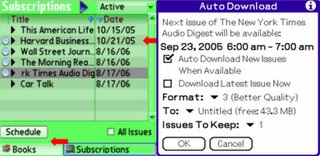 here you want to store them. Then using the audio player software that is provided you listen to the file just like an MP3 song, with the ability to skip to whatever section or article you are interested in. Now if you squint you'll see a supply chain here, albeit one for digital assets.
The digital media supply chain is quietly, but quickly becoming a huge industry. Industry estimates say that at the end of 2005, people will have access to more than 100 billion gigabytes of digital content in the form of images, text, software code, device drivers, audio, music, video and graphics. Digitizing and managing this content can be vexing, unless you manage it just like you would auto parts or cans of soup - with a supply chain. Using supply chain best practices to manage digital content is estimated to be a $13 billion industry and even at 100 billion gig of data, I believe its just the beginning. The supply chain loop is similar to making a car. It's manufacturing=content creation, procurement=payment and logistics/distribution/fulfillment are duplicated similarly.
The next time you download a song from iTunes or a movie on demand from your cable company its a supply chain that makes it happen.
It's called AudibleAir and its very simple. Using a smartphone, such as a Palm Treo 600, you download a simple fulfillment application (see image) that schedules when you want to receive the files and w
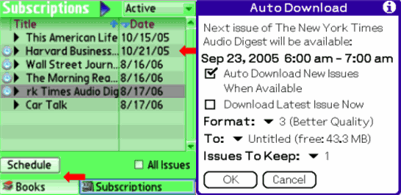 here you want to store them. Then using the audio player software that is provided you listen to the file just like an MP3 song, with the ability to skip to whatever section or article you are interested in. Now if you squint you'll see a supply chain here, albeit one for digital assets.
The digital media supply chain is quietly, but quickly becoming a huge industry. Industry estimates say that at the end of 2005, people will have access to more than 100 billion gigabytes of digital content in the form of images, text, software code, device drivers, audio, music, video and graphics. Digitizing and managing this content can be vexing, unless you manage it just like you would auto parts or cans of soup - with a supply chain. Using supply chain best practices to manage digital content is estimated to be a $13 billion industry and even at 100 billion gig of data, I believe its just the beginning. The supply chain loop is similar to making a car. It's manufacturing=content creation, procurement=payment and logistics/distribution/fulfillment are duplicated similarly.
The next time you download a song from iTunes or a movie on demand from your cable company its a supply chain that makes it happen.
Wednesday, January 11, 2006
Creating Innovation in the Supply Chain
Many supply chains struggle to improve their level of innovation and in many cases it doesn't have to be as challenging as it might sound. The solution starts with management and how they define supply chain innovation. Does supply chain innovation have to be a new algorithm that can distribute goods more efficiently or can supply chain innovation be something as simple as using a "lazy susan" or carousel that can rotate a PC in 360 degrees so assembly line workers can build it faster. It can be both. While the R&D department might be the only qualified team with the mathematical skills to develop a complex algorithm, everyone from manufacturing line workers to delivery drivers can also be innovative simply by sharing their ideas on how they get their job done. Several years ago, a truck driver at one of IBM's 3PLs suggested that we put the shipping label on the same side of the box before it gets loaded on the truck, eliminating the time it takes him to search for the packing slips. After sharing this with the rest of his team and other delivery drivers it considerably improved shipping and reduced the frustration that came with searching for the label.
The main thought here is everyone in the supply chain and the company for that matter should be given the goal to improve innovation. Here are some tips to help get you started:
1. Make innovation something every person does everyday.
2. Focus on collaboration as to share ideas and approaches.
3. Provide support at the local level.
4. Continuously celebrate innovative ideas and those that create them.
The main thought here is everyone in the supply chain and the company for that matter should be given the goal to improve innovation. Here are some tips to help get you started:
1. Make innovation something every person does everyday.
2. Focus on collaboration as to share ideas and approaches.
3. Provide support at the local level.
4. Continuously celebrate innovative ideas and those that create them.
Tuesday, January 03, 2006
Supply Chain Failures Under the Christmas Tree
First let me thank you for a successful 2005 as a continued reader...now back to the supply chain. In the final weeks of 2005 I checked one more port off my list - Miami. I spent the New Year in South Beach which is just a few miles from the Port of Miami. Security was thankfully tight, so I couldn't get too close, but it has significantly more capacity then the Port of Seattle/Tacoma.
Towards the end of 2005 I also witnessed a few supply chain failures on Christmas Day. My brother and went dutch on a snow blower for my dad. While the snow blower did arrive on time, December 23rd, it was missing the ignition key. So I phoned the retailer who promptly told me they were out of stock and suggested that I call the manufacturer. Waiting for only a few minutes the customer service rep was a little too friendly and admitted that I was the fifth customer in the last hour that complained to her about the keys missing. Knowing that this is a supply chain failure I asked to speak with someone more knowledgeable about the details. Apparently, the manufacturer shipped 500 snow blowers knowing that the keys were missing with the strategy that they would rather sell them without the keys instead of counting them in inventory at their warehouse. After explaining to him that their are several flaws in that strategy I requested for the keys to be shipped overnight, which they were at a cost of $12. So i wonder if the strategy included the $6000 if would cost to ship these keys to the 500 neglected customers, not to mention the huge hit to customer satisfaction? Failure indeed. The sad part is that I have read several articles on the supply chain expertise of this manufacturer in the trade press, so to witness this first hand was quite revealing.
The second failure was at my in-laws house while I installed a Wi-Fi network. The actual install was flawless (I highly recommend the Linksys products), but when it came to connecting the Ethernet wire to the PC the Ethernet card was so loose that I couldn't keep a strong connection. After searching the web it turns out that I wasn't the only one with this model with an ethernet problem. Eventually I had to make a trip to Staples and replaced the card, but these should be supply chain problems of ten years ago, not the supply chains of today. Let's see what awaits us in 2006.
Towards the end of 2005 I also witnessed a few supply chain failures on Christmas Day. My brother and went dutch on a snow blower for my dad. While the snow blower did arrive on time, December 23rd, it was missing the ignition key. So I phoned the retailer who promptly told me they were out of stock and suggested that I call the manufacturer.
 Waiting for only a few minutes the customer service rep was a little too friendly and admitted that I was the fifth customer in the last hour that complained to her about the keys missing. Knowing that this is a supply chain failure I asked to speak with someone more knowledgeable about the details. Apparently, the manufacturer shipped 500 snow blowers knowing that the keys were missing with the strategy that they would rather sell them without the keys instead of counting them in inventory at their warehouse. After explaining to him that their are several flaws in that strategy I requested for the keys to be shipped overnight, which they were at a cost of $12. So i wonder if the strategy included the $6000 if would cost to ship these keys to the 500 neglected customers, not to mention the huge hit to customer satisfaction? Failure indeed. The sad part is that I have read several articles on the supply chain expertise of this manufacturer in the trade press, so to witness this first hand was quite revealing.
The second failure was at my in-laws house while I installed a Wi-Fi network. The actual install was flawless (I highly recommend the Linksys products), but when it came to connecting the Ethernet wire to the PC the Ethernet card was so loose that I couldn't keep a strong connection. After searching the web it turns out that I wasn't the only one with this model with an ethernet problem. Eventually I had to make a trip to Staples and replaced the card, but these should be supply chain problems of ten years ago, not the supply chains of today. Let's see what awaits us in 2006.
Subscribe to:
Posts (Atom)