Monday, November 28, 2005

Kiosks Playing an Increasing Role in Supply Chains

Kiosks have been around for as long as I can remember. Whether it was to withdraw money at the bank or check into a hotel - overall kiosks have made life just a little easier for consumers. While they have traditionally been thought of to improve customer service, some kiosks are being installed to cut costs as well, particularly logistics related costs.

For example, several retailers are looking to eliminate logistics costs by using kiosks to sell DVDs. Using a server that can store thousands of movies, consumers can simply use the kiosk to select the movie of their choice and have it burned on the spot for a fee. The use of the kiosk can also free up aisles of shelf space that are used to store the discs and can eliminate the need for reverse logistics when it comes to returning DVDs that don't sell. Something like 80 percent of DVD sales are from the first two weeks of availability. The same application could be used for music, video games, audio books and even printed books.

Stereolithography can take this idea even a step further. Stereolithography also known as 3D printing, allows users to create solid, plastic, three-dimensional objects in a matter of hours. While a stereolithography machine costs thousands of dollars right now, what if a company could create a consumer model that you can hook up to you PC like a printer, but instead of printing a receipt you could actually produce a usable and tangible 3D product, such as a vase or a lawn sprinkler like the photo to the right. Think about the implications for logistics. While this is very pie in the sky the technology is available today and with increasingly demanding consumers, it may not be that far off.

Thursday, November 17, 2005

What Forprofits Can Learn from Nonprofits

Earlier this week I attended an event at the Ritz in Tysons Corner, Virginia where roughly 15 CEOs and supply chain senior vice presidents representing as many companies sat in on eight hours worth of presentations. One of the attendees was a company called the Georgia Center for NonProfits (GCN) and I spoke with the CEO Karen Beavor over oyster shooters and caviar. It's was quite decadent. Anyway, I found Ms. Beavor's company rather unique. Basically, they aggregate the spend for 1,400 non-profits that represent $19 billion in spending power. The nonprofits that participate have benefited from, on average, a 10% reduction in the purchasing of everything from office supplies to transportation services. GCN clients also expect to halve procurement operating costs and dramatically improve requisition-to-pay efficiencies and effectiveness. Two considerable savings, when you consider that every penny saved can be applied to helping the elderly, to the sick to the disabled.

Now think about the typical business that has a dozen different divisions that doesn't aggregate spend. The same model could be applied particularly for small businesses that don't have the spending power, procurement skills and infrastructure. If procurement isn't your core competency, you should be asking yourself, "why keep it in-house"?

Saturday, November 12, 2005

Looking for a Few Good Corporations

The basic premise of supply chain security is easy enough to understand. If a cargo ship is carrying 300 containers and just one of those containers has contraband it's going to have ramifications on the remaining 299. I don't want an IBM product to be one of those 299, or the 1 container with contraband for that matter. Without posting any challenges to any "evil-doers" IBM is publicly talking about how we are trying to prevent this from happening, to share our best practices and experiences with both clients and competitors alike. But unfortunately we one of the only few.

As my basic example illustrates, whether your company ships products via truck, ship, plane or train, we all need to stand side by side as a united front. And in some cases standing side by side requires a public forum. Recently I was asking several large corporations to participate in a public roundtable discussion to discuss what they are doing to secure their own supply chain to share their best practices with others. One of the companies viewed their security strategy as a competitive advantage and the other two didn't want to be the poster child for supply chain security, because they were afraid of egging on attacks. While I can appreciate it, it doesn't make sense.

Obviously, the company that views supply chain security as a competitive advantage is missing the boat (pun intended). He could have the greatest supply chain security infrastructure in the world, but if his product enters the Port of Baltimore and his competitors shipment implodes at the Port of Long Beach, the US Dept of Homeland Security is going to close down both ports and his shipment is going to sit for days, maybe weeks.

While I understand not wanting to draw attention to oneself, it can be done subtly. I'm not asking anyone to host a contest inviting terrorist to attempt an attack, but speaking with a reporter or two or presenting at a tradeshow seems reasonable enough.

Therefore, I am looking for a few good corporations looking to join me publicly in sharing supply chain security best practices. If you are interested please post me a message or email me.

Thursday, November 03, 2005

Logistics for Men


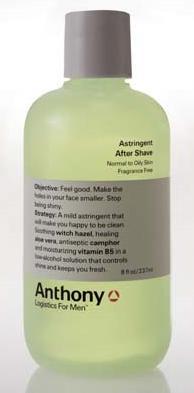
This week's post is going to lean more on the side of humor, so bare with me. So I was dragged to Sephora, a perfume and cosmetics store, last weekend with my wife. Besides picking up a huge headache from the thousands of scents, I also picked up a bottle of shaving astringent. Not because I need an $18 bottle of astringent, but because of the name of the company Anthony's Logistics for Men. Egh? Do men need logistics? After looking up the dictionary's definition for logistics apparently we do. Logistics is defined by dictionary.com as "the aspect of military operations that deals with the procurement, distribution, maintenance, and replacement of materiel and personnel." While keeping my skin acne free is not exactly a military operation it does involve maintenance. So by Anthony's view, who was looking for a set of products that help men with their personal supply chain of face, shave, body and hair - so I guess oddly enough it makes sense in a Barbie meets Sgt. Slaughter kind of way .

So once again I have illustrated how the supply chain effects your daily life. Next week, how to hire your personnel Chief Procurement Officer to help curb the costs of food shopping.

FYI: While the astringent burns quite a bit, it actually works.